It's hard to know quite what to say about this book, but I was loathe to leave it out of these never-ending blog posts as it's actually turned out to be one of the most enjoyable reads I've had so far this year. I didn't quite expect this; whilst I enjoyed the previous Gale book I read, Notes from an Exhibition, it only vaguely sticks in my mind, and the main thing I remember is that I enjoyed it more than my mum did. I bought this one off the strength of the blurb and because it was only £2.
The basic premise is that a young disabled man decides to take his own life, and invites his vicar to (unknowingly) be with him in his final moments. Everything then apparently fractures around this instance and things will never be the same again.
Only that isn't quite what happens. Instead, Gale then takes the story backwards, forwards and sideways in time which can be quite disorientating if you're not paying attention. We hear from the vicar's wife before she met the vicar, the vicar himself aged eight, the vicar's children aged eleven and thirty four, the disabled man aged fifteen, the disabled man's mother before he was born. Each chapter reveals a little more about the interconnected nature of this small village in Cornwall. I really enjoyed getting to know these different characters and to experience Gale's obvious love for the county. There was a sense of sympathy and depth to these characters that I've only found rarely outside of Maeve Binchy novels. Here were some characters I could really get to grips with and understand, and on the whole they were quite nice, which, as I've blogged about before, I like to have in a character.
My one real criticism is one which will probably put a lot of people off reading it: there isn't really a huge amount of plot. I mean, things happen, pretty ordinary every day things, but mainly twenty to thirty years before the novel even begins. To claim that life in the village shatters around the man's decision to kill himself is untrue: things do change but the real earth-shattering secrets never really come to light to the wider community. The ending is convenient and a little bit of a cop out to ensure all remaining characters have a happy ending, but I'm not sure I'd have enjoyed a bleaker ending.
So, one I'd recommend if you like reading about people, but not if you relish high-action and drama.
Ramblings about books, films, cakes, weight loss and likely some terrible celebrity gossip. Politics is very unlikely.
Sunday, 14 April 2013
Friday, 12 April 2013
Farmyard Friday #9: Faster than a speeding cat?
Of all the animals featured so far on Farmyard Fridays, cats are probably the most divisive. People tend to either really love cats or hate them. The haters have many reasons, often allergies, or cats aloofness, or their perceived 'evil' status. The latter can be laid at the door of Pope Innocent VIII, who is certainly not innocent of libelling felines; during the Spanish Inquisition he condemned cats as being evil and had them burned. This all backfired though as this led to a rise in the rat population which led to the Black Death: Cats 1 Humans 0.
I like cats, and whilst they're not wholly associated with farmyards as pigs and sheep are, they are an essential part of farm life. It's also coming up to four years since I said goodbye to my lovely cat, so forgive me for indulging myself.
There are hundreds of facts about cats as they are a fascinating and strange species. Perhaps this is another reason why so many people dislike them, as they can be so bizarre and alien. They've made far fewer concessions to humans than dogs have in the process of domestication meaning that you can end up sharing your home with a complete stranger. Dogs live underneath humans' feet, only being allowed out when dictated by their owners and being accompanied on their walks. Cats take themselves off as and when they please and live a very secretive life, only returning when they want an ear rub or some woefully expensive food (did you know you can now get pate for cats? Like, what?) Basically, cats have made us their slaves: Cats 2 Humans 0.
Cats however can boast of defeating us in yet another way apart from being hideously independent and infinitely better rat catchers than us. Everybody knows cheetahs are the fastest land mammal (although only over short distances) and in comparison to them, the humble domestic moggy's 30mph top speed seems pretty pathetic. But let's not compare the cat to the cheetah; let's compare them to other things. Cats can run at the speed limit for built up areas. They can run as fast as a kangaroo can hop and a bear can run. In a race with an elephant, black mamba or squirrel, a cat would win (probably just as well in the case of the black mamba). In fairness to the cat, even a whippet only runs 5mph faster than a cat.
But here comes the biggie, the one which shows that cats are pretty much superior to humans: cats run 3mph faster than Usain Bolt.
Cats 3 Humans 0
Farmyard Friday Fact #9: The domestic cat can run at a top speed of 30mph - faster than Usain Bolt.
Admittedly, most of the time, they're doing stuff like this. Cats 1 Dogs 0.
Sunday, 7 April 2013
80 Books No.25: The Fault In Our Stars by John Green
I sort of knew what I was getting with this book. I read John Green's earlier novel Looking for Alaska earlier this year on the recommendation of a student. It was exactly what would probably appeal to a teenage girl: slightly law-breaking characters, an absence of parents, so therefore a plethora of freedom, and a doomed romance. Having looked around on the internet, Looking for Alaska is viewed with eye-rolls by many people with far greater taste in books than I have. And yeah, okay, it was sentimental and quite calculating in its attempts to sway the reader's emotions, and Alaska is a stupid name for a girl, and it did romanticise stuff which frankly shouldn't be romanticised. But it was entertaining enough as a read.
So to The Fault in our Stars. '#1 New York Times Bestseller' the front cover shouts. This in itself is not a recommendation as some real dross makes it to the top of that list, but I was still curious to read it as it comes up on Amazon so often as a suggested read for me that it seemed rude not to. I went in with reasonably low expectations, given what I knew of Looking for Alaska. And it sort of worked.
The Fault in our Stars is about Hazel who has reasonably terminal cancer; I say reasonably because Green invented some mythical drug which stops her cancer spreading but will never cure it, keeping her on oxygen at all hours due to her reduced lung capacity. Either way, she's a sick girl. She meets Augustus at a support group and the two form an instant connection. Over the course of the novel they become obsessed with a book and finding out what happened next. It's clear from reading this and Alaska that Green is a bit of a book fanatic himself, as his characters always have a thing for books - often quite a quirky thing.
The book deals with the dark subject matter lightly and with a little black humour. This can come across quite unrealistic, but then I have no idea how teenagers with incurable illnesses deal with it - this seems as believable way as any. You can't, after all, go around being miserable all the time. I liked how, whilst the main focus of the book was Hazel and Augustus's relationship, but it inadvertently all led back to Hazel's relationship with her parents and how the parents of a terminally ill child cope with the day-to-day reality. This could all become depressing - it doesn't, so for that Green should be praised.
It's a very quotable book which is also probably why teenagers seem to have latched onto Green's work in such a way; they so enjoy putting cryptically 'profound' things on Twitter. The quotes walk a fine line between memorable and unutterably saccharine, but I think that's probably the area I best occupy myself, so I'm not going to criticise it for that. Certainly a quick Google image search of 'the fault in our stars' brings up endless amounts of fan-created jpegs like these:
It would be mean of me to give the ending away, although given the subject matter, narrator and general teen-novel conventions, it is largely very obvious. Also anybody who has ever read Cherie Bennett's Goodbye Best Friend (it surely can't only have been me?!) will probably see some parallels between the two novels. It's not original and it's not especially poetically done, but The Fault in our Stars is a reasonable enough read to pass some time.
Friday, 5 April 2013
Farmyard Friday #8: Help a sheep brother out
Something really strange happened today. I looked out of the window and - it was (albeit briefly) sunny. I'm not making this up: it wasn't snowing, it wasn't raining and the sky was something other than grey for a whole series of minutes. Could it be that spring is finally here?
One sure fire way to know whether spring is here or not is whether there are lambs in the fields, and I have a reliable source (Countryfile's Adam - surely one of the hottest farmers ever) that this has indeed happened.
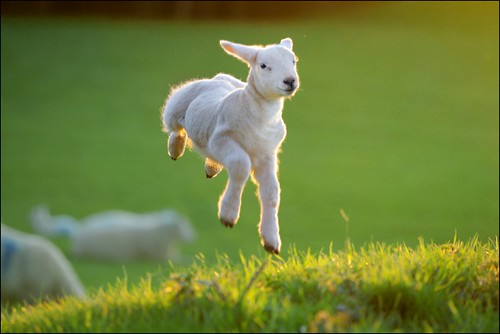
Cue gratuitous lamb photo
Lambs are a very Easter-y kind of animal, and given that my Easter break doesn't end for another nine days, and that I'm not even apologising for that, I figured I could probably spin out another Easter special Farmyard Friday. However, this fact isn't as cheerful as that little chap above would have you believe.
It's always struck me about baby animals that they're just so much more fun than adult animals. Watch calves or lambs or foals or chicks and they're so much more interesting watch than their adult counterparts. Even puppies and kittens gambol about a little more, although perhaps the complete domestication of dogs and cats means that they tend to live their whole lives in a strange suspension of ageing, a little like Louis Spence or Madonna. Farmyard animals seem to acquire a more mature standing much sooner in their lives and stop the skipping around that we see above. Sheep, in general, seem to have their feet much more firmly on the ground than lambs.
And this is likely for a very good reason. Becoming mature, even for humans, is less about getting bigger and having more freedom, and more about taking greater responsibility for yourself and others. Even with their flock-like mentality, sheep must know this, and so their not jumping around with all four feet off the ground is sensible. Because look what could happen if it mistimed its landing:
Yes, it all seem super-funny, until you realise that poor sheep here can't get back up from that position; they are unable to flip themselves back over. Even more worrying, they can actually die from being in that position too long as they were simply never designed to lie on their back. Their digestive system slows down and they fill with gas and ultimately suffocate to death.
Not so funny now, right?
However, you, yes, you can save a sheep's life. If you see a sheep lying on its back, it isn't just chilling. It needs help. With one quick flip over, they're all good again. So help a sheep brother out and flip them over.
Farmyard Friday Fact #8: A sheep will die if it lies on its back too long.
Another cute lamb pic to cheer everyone up after that depressing fact.
Wednesday, 3 April 2013
80 Books No.24: Gone Girl by Gillian Flynn
This is a book which has been massively hyped up over the last few months, with bookstores shoving it to the front and people raving about it online. It's been optioned for a film by Reese Witherspoon's production company and the author is working on the screenplay. So it'll become yet another one of those 'which is better, the film or the book?' I'll get back to you on that particular debate when the film is released.
For now, I'll concentrate on the book. This is billed as a thriller, albeit with some deviations from the genre, and I don't usually get very involved in thrillers. I've read Dan Brown's Langdon books (apart from The Lost Symbol - not religious enough for me) and a couple of others (usually religiously themed) but largely not been interested enough to pick up many more. I bought this one largely because it was being so hyped up, and because the front cover is cracking - I love a black front cover.
The general premise is that Nick Dunne's wife Amy goes missing on their fifth wedding anniversary. There are signs of a struggle and strange clues, and Nick is being shifty for some reason. The chapters alternate between Nick's narration of the investigation into Amy's disappearance, and Amy's diary entries from the last seven years. The police have their suspicions and to this end, it's pretty obvious where the novel is going. Then it all goes crazy and you don't trust anything again.
Unreliable and hazy narrators are a really interesting device to use, if they're done well. I'm thinking here of Plath's The Bell Jar, Kesey's One Flew Over the Cuckoo's Nest and even Shriver's We Need To Talk About Kevin (yet another 'which is better, the book or the film?' Ans: the film makes no sense without having watched the film). They keep you guessing and second-guessing exactly what is going on. Flynn uses them well here, until you can no longer decide whether you should believe Nick or Amy. It's a really effective reminder that any marriage has two sides, as the front cover's strapline says.
Both Nick and Amy are largely unsympathetic characters, Amy more so. It's hard to say much more without spoiling the book, so suffice to say that she is the more unreliable narrator of the two. It all becomes clear once you've read it!
Overall, an enjoyable book, one of the few I can genuinely say I've enjoyed this year. Well worth a read despite the hype.
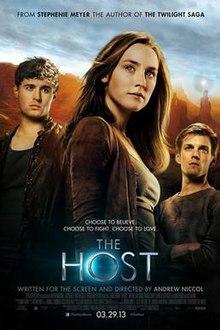
The Host
In my review of The Silver Linings Playbook, I discussed some of the differences between the book and the film in the ongoing issue of which is better. On that occasion I concluded that both formats shed a little more light on the characters (basically fudging the issue in a typical Literature graduate manner).
With The Host, I've found my conclusion much easier to come to, and given that this is a Stephenie Meyer based text, it might be a little surprising. Let me state on record right here that I have read all four Twilight novels; I've seen all five Twilight films (I'm not including The Short Second Life of Bree Tanner in this list because, let's face it, who has the time for that?) I paid actual money to see those films at the cinema. Perhaps most appallingly, I've even read that godawful Twilight-fanfiction rip off, Fifty Shades of Grey - it's probably testament to how bad E L James is as a writer that she makes Meyer look talented. I've not enjoyed very much of these things, but anybody who reads this blog regularly has probably gathered by now that I'm incredibly picky with books and films: my not enjoying something is much like everybody else shrugging and saying 'it was okay.'
But The Host I enjoyed. I remember reading it pretty compulsively and getting quite involved in the whole Wanda-Ian-Jared-Melanie odd triangle/square thing. I loved Ian, but also like Jared. In fact, it was really only Melanie who irritated me, suffering as she was from a little bit of Bella Swan-itis. Yes, this was essentially the same story only with aliens rather than vampires, but at least Wanda, and to some extent Melanie, actually considered the effects of their actions upon others, which was refreshing after Bella and Edward's 'but we love each other' for thousands of pages.
So I was really excited when the film came out. I was looking forward to seeing it all played out on screen and to not seeing K-Patz clogging up the screen with their overly brooding and miserable presences. I was hopeful.
In the end, though, it was all a bit underwhelming. Firstly, the screenplay was a bit poorly put together in my opinion. Possibly the cheesy dialogue was lifted straight from the novel and it's just a bit more palatable in printed form; certainly the suspension of disbelief was easier for me when reading the novel than when watching the film. Because of the sometimes duff line, the acting was a bit wooden at times, although Saoirse Ronan did a good job acting against herself and coming across as two different characters, making Wanda and Melanie distinct entities.
Secondly, the film was quite slow. Again, not wholly its fault: the novel is pretty long and from what I can recall, Wanda and Melanie spend ages in the desert getting to the secret hideaway; I probably got a bit bored at that point of the novel too. But watching the film reminded me what I had loved about the novel, and the film didn't quite capture it. I loved how Wanda was gradually accepted into the colony, the chessboard moves between her, Jared and Ian, and how sweet the relationship between Ian and her was. This was rushed, in my opinion, in the film, and I found myself sniggering instead of swooning. It wasn't really made clear why Wanda preferred Ian to Jared; the characters needed bulking out a little more, although both actors were pretty (more so than Edward and Jacob in Twilight so at least they hit those buttons for me).
It was, in summary, a pretty disappointing adaptation and I would urge anybody who has even a passing interest to read the novel.
Monday, 1 April 2013
80 Books No.23:Luke and Jon by Robert Williams
Like True Things About Me I was a little swayed into reading this due to one of the reviews on the front page. This time I at least actually understood the source of the review; the Financial Times is a pretty reputable publication, although I never knew they reviewed books. This novel was described as 'The kind of book that reminds you why, as a child, you started reading the first place.' Admittedly that is a pretty sweeping statement, as most of us begin reading fairytales or books about cats in boxes: no witches or adventurous felines were present in this story (although actually both are referenced!)
So I wouldn't agree with the FT on this occasion. However, what I did find was a likeable enough novel, with manageable chapters, a decent enough story and reasonably well-written. The Amazon reviews mainly criticise this for having no punctuation, but this turns out to be a Kindle issue which has now been fixed. As I'm a Luddite and this book had actual paper pages and everything, this was not a problem for me.
Luke's mother dies and he and his father move miles away up some bleak hill: think Wuthering Heights or Heidi and you're getting there. On this hill, Luke meets Jon, a strange boy who wears old fashioned clothes and lives with his grandparents. The blurb set me up for something really dark, like Jon had murdered his absent parents (something I'm not ruling out of the other Williams book in my pile, How the trouble started). As I've established previously, I like a disturbing novel about murderous teenagers, so this one let me down a little. I'd have liked to know more about Jon's weirdo life and what had happened to his parents, but Williams seems to have been more interested in the relationship between the boys and Luke's dad. Fair enough.
It was a quick read and if you want something simple but not complete trash, this would probably do you.
Subscribe to:
Posts (Atom)