Thursday, 19 September 2013

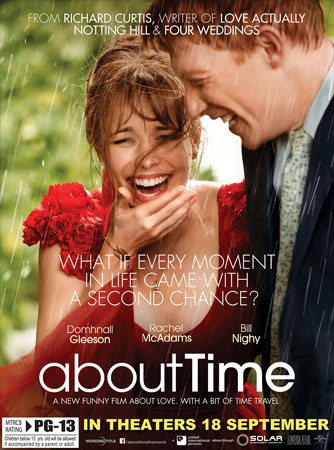
About Time


Richard Curtis has a bad rep. It's true that none of his films really have the hallmarks of a cinematic genius and in some manner resemble a feature-length TV drama. The storylines tend to be quite schmaltzy and in some ways entirely predictable: Hugh Grant (or someone much like him) will always get the girl.

About Time is, he claims, the last film he's going to direct/write. His previous films, particularly Four Weddings and a Funeral, Notting Hill and Love Actually have become quite seminal rom-coms. Where these are also much like a who's who of British cinema, About Time falls down. There are famous actors involved, most notably Bill Nighy, but for the most part it seems to be younger up-and-coming actors - i.e. the Hugh Grants of the future. However, in so many ways, it completely slams the Curtis' other offerings. I'll explain why.

Firstly, the lead characters and actors are very charming. There was no character in this that I wanted to get off the screen, whereas Andie McDowell and Julia Roberts need to do one in their respective films. Rachel MacAdams is one of my favourite underrated actresses: I have loved her since The Notebook and Mean Girls, yet she's never really come good on the fact that she is a really versatile performer. She's also kookily stunning. Domhnall Gleeson was also utterly delightful as Tim, the main character, even if he does sound identical to Hugh Grant. Billy Nighy was a wonderful dad. They all fit their parts really well.

The plot itself is pretty ridiculous: Tim finds out that the men in his family have always had the ability to time travel back through their own timelines. The science of this was massively glossed over and there were a wealth of paradoxes, so in this respect it was less well-plotted than The Time Traveler's Wife (loved the book, disliked the film, despite Rachel MacAdams - she is better in this). For much of the film, it lacked some conflict as the relationship between Tim and Mary, after a shaky start where he almost missed ever meeting her, trotted along nicely. The sub-plot of Tim's disaster-zone of a sister was a little too underplayed for much of the film and I think potentially she could have been either given more to do or removed entirely. However, I see nothing wrong with sometimes watching a film which is just nice; I really enjoyed watching Tim and Mary together for their relationship alone. In fact, I could have watched an entire film which was just that ordinary and lovely.

However, the lack of conflict for a large chunk of the film means than when the thunderbolt hits, it hits hard. I haven't cried in the cinema for a long time. Tears were rolling down my cheeks during the last twenty minutes of this film. I shan't spoil it for anybody who wishes to see it, but it's enough to say that the ordinariness of everything set against the bonkers world of time travel really works here, much as it does in my long-time love Doctor Who. Indeed, this film shares many of the themes of Curtis' episode from 2010, Vincent and the Doctor which talked a lot about ordinary life being utterly extraordinary if looked at the right way. The pain of life is something addressed by both film and episode, and leads into one of my favourite quotations from the TV show:


About Time is essentially a love story, between a man and a woman, and a son and his father. It talked of an ordinary life and how each day can be wonderful if we let it. If it was saccharine and schmaltzy, I don't care. It may not be the world's greatest film, but it has heart and soul and truisms and was frankly lovely. There are not enough lovely things in the world in my opinion. I adored it.

Friday, 30 August 2013

Farmyard Fridays #11: One Sheep Five Ways


I've mentioned before in Farmyard Fridays that grown sheep can tend to seem a little boring in comparison to their offspring. They definitely don't have the charm and personality that, for instance, goats or donkeys have, at least on the surface. However, I feel I've been maligning the species for a while now, and it's unfair. They may not have the same quirks and foibles of their caprine cousins, but they do have the edge over them in one way: they are super super useful.

Okay, so pigs are notoriously a useful farmyard feature. You can, so I have been informed, use every part of a pig in cooking. This is a pretty hideous thing to consider and I try not to most of the time. Sheep, however, are equally if not more useful, for the following reasons. I give you One Sheep Five Ways - how you can maximise the use of your sheep.

1. Obviously, there is one thing staring you in the face about sheep, at least for half of the year. They have a seriously epic fleece which has been farmed for perhaps as long as 8000 years. Being able to make clothes out of an animal and still retain the animal does set them apart from pretty much every other farmyard creature; skinning a cow for leather does tend to render the cow null and void. What's more, the fleece will grow back and you can do the same again the next year. This may seem obvious but it is pretty incredible when you think about it. Sheep can go from this:


to this:


in sheer (!) seconds in the right hand. And from that can come so many useful things which we use without thinking about them: jumpers and socks and blankets and sheepskin rugs and this oh so useful and decorative set of figures.


(It's a knitted Archbishop of Canterbury! Like, how useful is that? God bless sheep.)

It doesn't stop with clothes though. Oh no. There's more that woolly fleece of goodness can offer up yet.

2. Lanolin. There's a word you'll have seen hundreds of times in your life, but I for couldn't say where I've seen it until recently. There are so many uses for this grease that it's hard to know where to start. Here's possibly the most common household lanolin product:

However, this waxy substance is also used in a variety of cosmetics, as lubricant for some musical instruments and to break in baseball mitts. It's pretty multi-purpose, and whilst some people are allergic to it, it's an extremely common ingredient in many products.

Lanolin is a grease found in the sebaceous glands of wool-bearing animals. Basically, it's the grease in a sheep's fleece. It can be squeezed out before the fleece is used for other purposes as we've already looked at above. So you can not only clothe yourself using your sheep, you can moisturise and generally prettify yourself too.

Your sheep isn't finished yet though. With a bit of training you can absolutely

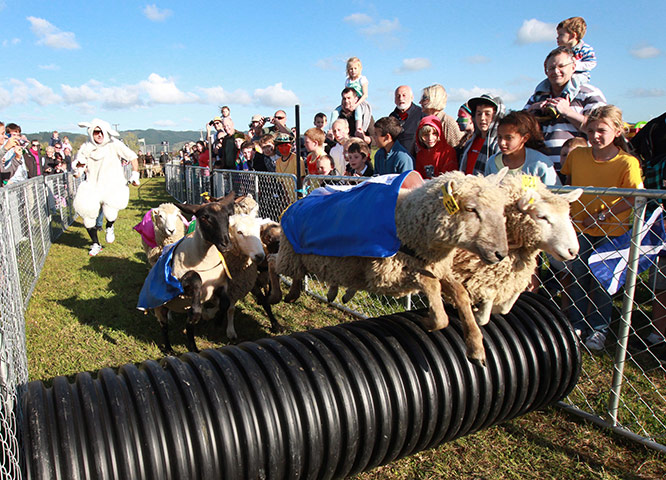
3. Race your sheep. I think this pretty much speaks for itself. It's not the Grand National or the Derby but look!


It's sheep freaking racing! And jumping!


If this is not starting to make you want a sheep, I don't know if we'd ever be friends.

Of course, all of this requires some effort on your part. Shearing sheep is a skill and I imagine training a sheep to bounce over barrels isn't really a walk in the park. All of this is bound to make you hungry. So why not try

4. Milking your sheep. I know, it sounds disgusting, but sheep produce milk as any mammal does, and whilst goats' milk has been the increasingly popular alternative to cows' milk in recent years, sheep's milk is used in products such as feta, Roquefort and ricotta. It is significantly higher in fats, proteins and minerals than cows' milk, making it more calorific but perfect for cheese making. You can therefore have a munch on your homemade produce whilst wrestling your sheep around a racetrack. It will definitely give you energy.

And then, alas, the end comes to us all. When you've had enough of shearing and training and milking and generally tending to your sheep, you can always

5. Eat your sheep. Dependent upon the age of your sheep, you can produce lamb, hogget or mutton, and the organs are also popularly eaten as offal. Admittedly, it's not the most healthy meat around, with a nutritional profile to beef, but it is pretty tasty. It's very hard to look at this and not feel a tad peckish


And besides, if you want to raise up your next sheep friend, you'll need some fuel for the task ahead.

Farmyard Fridays Fact #11: Sheep are super super useful.

A sixth use for your sheep has come to light in the last week. Sandwiched nicely in between uses 4 and 5, comes this ingenious use for your sheep:

Shakhter Karagandy threatened with disciplinary proceedings over sheep sacrifice ritual before games

It may have worked for them; they did, after all, beat Celtic 2-0, so never rule this sixth use for your sheep out. It is, however, possibly a step too far for some of us, meaning that this particularly hypothetical sheep will be saved from this ritual.

This week's Farmyard Friday is absolutely inspired by a visit to West Lodge Rural Centre in Northamptonshire a couple of weeks ago which was frankly amazing and well worth a visit for anyone with or without children.


Tuesday, 20 August 2013

80 Books No.69: Z for Zachariah by Robert C O'Brien


In a weird coincidence, like Buddy, this book has links to my own school life as well as being a find in the book cupboard. I didn't read Z for Zachariah when I was at school, but we did do Mrs Frisby and the Rats of NIMH written by the same author. And I hated it. Looking back, one has to wonder why I liked English so much because I pretty much hated all the books I did until GCSE - a trend which is kind of reflected in my own teaching to date. I just remember Mrs Frisby being so stupid and irritating so why I thought this would be any different is beyond me.

This was worse. I couldn't believe it was as bad as it got in the last seventy or so pages. Until that point I had sort of been bobbing along with it, feeling that it wasn't very suitable as a reader at school, but was actually quite interesting. Set in a post-nuclear world, it's the story of a girl who survives when everybody else doesn't and what happens when a strange man arrives. It is a slow starter but when he suffers from radiation poisoning it gets a bit more interesting. After that, it just becomes odd: he becomes all sinister and she is uneasy, but spends most of the rest of the novel detailing her efforts to plant crops and tend the land. I have to be honest in that I skim read the end of this and feel almost no guilt in doing so. I was so bored.

Disappointing and now I have to decide whether we keep the books or not. Whatever, they'll be buried away on a top shelf at the very most.

80 Books No.68: Buddy by Nigel Hinton


This book is a tale of two Bullens, a 13-year-old Bullen and a 26-year-old one. At 13, I hated this book when we did it at school. I remember loathing it and, having re-read it, I suspect I never even finished it, despite having to complete quite a bit of work on it. At 26, I found it in the school book cupboard and decided to re-read it because there's enough there for one class to do it and money's too tight to mention.

Thirteen years give me a bit of perspective and Buddy is not unfinishable. Indeed, in some ways, it is actually an alright book which tells a reasonably interesting story. It is pretty grim, with broken homes and poverty and criminality and general lack-of-fitting-in-ness. It is also reasonably dated now, in terms of situations and some attitudes towards different races (although this is frowned upon within the novel by the characters we sympathise with). It would need contextualising, but then so will the other texts I've ear-marked as being appropriate for year 7. It is now a book I would consider teaching which at least shows progress from when I was at school. It is also, however, yet another miserable book: why are all school set texts so depressing?

Also, check out that front cover. What on earth is wrong with Buddy's face in it? I mean, it does pretty much reflect the grim miserable-ness of the novel, but why is he green? It's such an odd front cover. Especially when you compare it with this more updated version:


Here, Buddy has been made older and, dare I say, more attractive? More like somebody off of Grange Hill circa 2000 than Byker Grove circa 1988. This is admirable in its attempt to appeal more to kids, but is also a little misleading.

There is apparently also a film. I'm imagining it to be something like a cross between Kes and those strange Look and Read BBC schools programmes in the 80s and 90s.

80 Books No.67: Why the Whales Came by Michael Morpurgo


I've spent some time over the last week or so tidying out the book cupboard at work (something that will hopefully be completed this week). It is impossible to believe how many books there are in there, some of them barely touched. Why the Whales Came is a reasonably old book, in comparison to my new purchase of The Hunger Games anyway. It is a Morpurgo classic, and for some reason kids seem to love Michael Morpurgo. I can't say as I entirely understand why, even after reading this book.

It is a short enough book with a decent enough story of two children in 1914 (why always the war, Morpurgo?) on the Isles of Scilly. Tales of curses and scary men had some correlation with things like To Kill a Mockingbird. It was a little fantastical, as I'm still not really sure 'why the whales came' apart from some curse that was apparently on the island. That was a little frustrating, but maybe I missed a key point.

The story was predictable and ended too neatly, but it was interesting enough whilst it lasted. Perhaps my lack of enthusiasm comes from the fact that I was reading it till 4am one night because I couldn't sleep. Bitter, mumble mumble mumble.

It's on my redesigned curriculum for this year anyway.

80 Books No 66: Uglies by Scott Westerfield


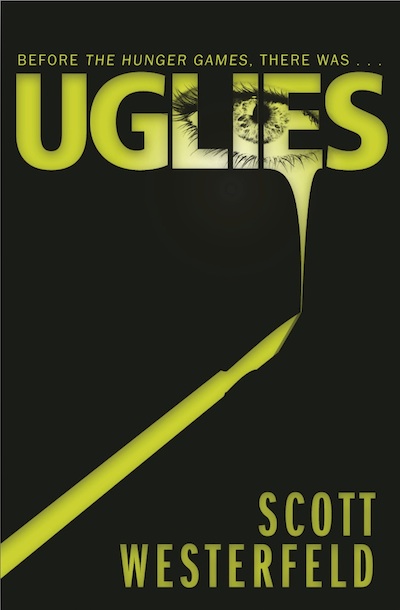
Those of you with eyes and a vague notion of the patterns in my reading can probably guess from simply looking at the book cover why this found itself from Asda's shelves into my trolley and to my house:
1) It references The Hunger Games and I loved The Hunger Games. This had several similarities to Suzanne Collins' trilogy, but as the cover says, actually came first.
2) It's YA in general which we already know I'm a little bit obsessed by.
3) It has a black front cover. Oh how I freaking love a black front cover.

So it was likely to be a hit. The general concept was also quite interesting without all of those elements: a world where judging people based on their looks has been eradicated by ensuring all people are turned 'pretty' at the age of 16 via extensive surgery. The Pretties then inhabit a different area than the Uglies and are subject to less stringent laws. Tally Youngblood is looking forward to becoming a Pretty until she meets Shay and is introduced to the world of the Smoke, an outlaw community where Uglies can live forever with the face they were born with.

Collins has obviously ripped quite a bit from Westerfield's idea here: the female character, the dystopian world, the burgeoning teenage relationships. However, Tally is a different kettle of fish from Katniss Everdeen, at least in some ways. Tally is happy to conform to society's expectations of her at first and only reluctantly challenges the status quo. However, in quite a bold move, Westerfield actually makes her quite unlikeable as a hero as she begins by intending to betray her friends. Yes, she overcomes this, but things still don't work out well. Katniss, whilst being a bit whiny at times, is at least admirable.

The novel dragged at first as it felt like so many other YA dystopian fictions I've read. It was when Tally left the city for the Smoke that it became more engaging and whilst the relationship with David was a little clumsy, the opening preview of Pretties at the end of the novel seemed to develop the story in a promising way. If I get the opportunity I'd probably read the rest of the series.

Uglies has also been optioned for a film, although it's a slow old process. Would be interesting see how exactly they'd cast it!

Wednesday, 14 August 2013

80 Books No.65: Until the Next Time by Kevin Fox


The amount of labels I've added to this post will demonstrate how hard this book was to categorise. I've hesitantly called it 'historical', although I'm not entirely sure 1970s Ireland and the Troubles are really consigned to the past; I've called it 'fantasy' due to the beliefs about and occurrences of reincarnation present throughout the narrative. I added 'thrilled' as Amazon categorises it as such. 'Romance' I'm definite about, as certain as I am that this is indeed a 'book'. This vein of uncertainties dogged me throughout the reading.

Sean Corrigan receives his uncle Michael's journal on his 21st birthday - an uncle he never knew about, if I remember correctly. This drags him from New York to rural Ireland to investigate what happened to his uncle in the 70s. The novel makes use of both Sean's 1996 first person narration and Michael's journal in order to tell the story. The author himself has said he found the dual narrative very easy to use as the voices of the characters were very similar and so was their story. This does, however, make it really rather confusing for the reader, an effect which was partially intended as the novel goes on to explore the idea that all of these characters have lived before and are doomed to keep repeating the same mistakes until they learn they lesson. In my opinion, it got a bit bogged down with this.

The confusing nature of the narrative meant this was quite a slow read for me, as part way through Michael's sections I'd have to remind myself that we were in the 1970s and he was on the run from US police, as opposed to Sean who seemed to have upped and left his life in America on a whim and some odd dreams. To confuse things further, Michael was frequently called 'Mickaleen' which was HIS uncle's (or great-uncles's) nickname - he'd been on the run from Irish nationalists. Then Sean was occasionally called 'Mickaleen' by people who'd known him when he was Michael...

I'd really recommend a flow chart if anybody else wants to try reading this. It was a fairly interesting story, certainly in its more 'historical' sections, although I preferred Sean as a character. The romantic element came in the form of Kate/Erin/whatever her name may now be, and Anne, who was a brilliantly drawn character. Fox really captured Irish conversation for me and the characters leapt off the page when they spoke. Definitely a writer who I would read something else from if it was slightly less convoluted and confusing.