Sunday, 31 March 2013

80 Books No.22: The Adoration of Jenna Fox by Mary E Pearson


This reminded me of a book called Eva which my year 7 English teacher tried to make me read at school. I remember reading maybe 50 pages and then claiming I'd finished it, just to get her off my back. I didn't enjoy the concept: that a girl's brain was transplanted into a chimp's as her parents worked with chimps. It wasn't my thing at age eleven and this probably serves as a timely reminder that I shouldn't try and force my students to read things they hate. Unfortunately this rules out much of the GCSE and A Level syllabus.

However, back on topic, The Adoration of Jenna Fox is a similar idea, albeit without the chimps. Jenna is involved in an horrific accident and is saved only by her father's medical break-throughs. The novel then follows her discovery of what has happened to her with some theological debates over what makes us human and how much medical intervention is too much. Her grandmother brings in a bit of religion, and there's a tiny bit of romance.

The themes surrounding the central plot are vaguely interesting, probably more to other people than to me, but even I was able to rethink some of the issues. I think I'd have engaged even more had Jenna been a more interesting character. Whilst part of her condition is about her finding out how to be 'the New Jenna', she also comes across as completely bland and characterless. The fact that all the characters are very similar in this respect suggests it's a case of poor writing than a clever narrative technique to reflect Jenna's struggle to regain her identity. The characters of Dane and Ethan are prime examples; Ethan was supposed to be some violent criminal but didn't have that in his character, whilst Dane was supposed to be threatening but did nothing.

The title of the novel refers to how Jenna's parents revere her even before the accident and how they'd do anything to make her perfect (something they literally have the opportunity to do after the accident). This is touched upon a few times, mainly with references to Jenna's dancing recitals. I'd have liked to see this expanded upon further, as it would have added extra drama to her attempts to form her own identity. There should have been more focus here, but there were so many plot strands that it lost some of its punch.

This is apparently the first in a series, which, given how this one ends, is rather strange. I'm not sure I'd read any more. It also seems to have had the film rights bought, which may work out quite well; it could be that this is one of those instances (like those mentioned in my review of The Silver Linings Playbook) where the film trumps the novel.

80 Books No.21: Trapped by Michael Northrop

A novel about high school teenagers trapped in their school as the worst snowstorm for <insert amount of years> batters the East Coast of America. This seemed totally up my street and not a little bit topical given not only Hurricane Sandy in the USA but also the crazy weather conditions in the UK this year. I'll admit I was also slightly swayed by the really cool chapter headings which made it seem like more and more of the pages were being covered in snow as the novel went on; I'm a sucker for gimmicky graphics.

On the topic of graphics, I want to make a point about this front cover, because I'm also quite easily swayed by a catchy cover (yes, yes, I know...). Now, based upon this cover, I assumed something off the chain was going to happen in this book, a preconception aided by the concluding statement of the blurb that 'As the days add up, the snow piles higher, and the empty halls grow colder and darker, the mounting pressure forces a devastating decision. . . .' That word, right there: devastating. I was seeing cannibalism, human sacrifices, something completely Lord of the Flies-esque. Not that I even particularly like Lord of the Flies, but I was hoping this might be an updated version that I could get on board with.

Suffice to say, that I didn't get what I was looking for. The novel started out well, much like Michael Grant's Gone did, with tension and reasonably likeable characters. The narrator was engaging enough and so were his friends, and there was a sense of mounting dread as the snow thickened and they became increasingly cut off from civilisation. I did think the author had thought through the idea of them being snowed in, considering the consequences of power failures, frozen pipes and even the sheer weight of snow upon an old roof, so on those counts he should be congratulated.

Unfortunately, on other counts, he lets the reader down in my view. One character is set up as a ticking timebomb, whilst another is the weirdo on campus who is probably more dangerous than that. There's girls to add temptation into everything, and testosterone running wild. More than enough ingredients to justify the bloodstained front cover and description of 'devastating' in my mind. And then... almost nothing happens. It's like Northrop sets all of this up and then sort of bottles it and to add insult to injury, the story just stops and leaves you with no pay off to all of this. It was another frustrating read, really, which could have been so much better.

I wouldn't discount Northrop in the future, but he'd have to do much better than this.

80 Books No.20: True Things About Me by Deborah Kay Davies


Trezza Azzopardi (apparently a novelist - no, I don't know either) is quoted on the front of this novel as claiming this book is 'The Bell Jar for the twenty-first century.' Now, nobody likes a novel about nymphomaniac mental patients more than I do, so this seemed a pretty perfect read, not least due to it being dirt cheap.

'Dirt' is probably a very good word to associate with this novel on reflection, and it makes me such a prude to say it. But this was just so tiresomely filthy, and I've read the entire Fifty Shades trilogy - surely the epitome of tiresome and tedious. The basic premise is, admittedly, pretty daft: ordinary girl has some wild sexual encounter in an underground car park and this bloke then takes over her life. It's unlikely, yes, but could have been quite interesting as a look into mental breakdowns and obsession. I'm not adverse to mental breakdowns and obsession; Wuthering Heights is one of my favourite books.

No, the main problem I had with this novel was that I just didn't believe in the main character. She was the narrator and yet she was so distanced and random that I didn't care what happened to her. The timeline of the plot was all over the place so I had no idea if we were talking days, weeks, months or years, and because of that, her relationship with the Big Bad Man was so difficult to get to grips with. It almost made Christian and Ana's relationship look plausible and believable. Strangely, it was her family and friends who I ended up liking and understanding more, which may have been Davies' purpose in presenting somebody in the middle of a breakdown. However, it was unclear whether she'd entered into this horrible relationship due to having a breakdown or her involvement with the Big Bad Man had led to her breakdown. Maybe, again, this was a deliberate act on the author's part to make it all more truthful to the experience of being mentally ill. Whatever, it made for a frustrating novel, not least because you never even find out the narrator's name, something which drove me insane in  Rebecca.

All in all, not a huge success from my viewpoint.

80 Books No.19: The Silver Linings Playbook by Matthew Quick


Silver Linings Playbook was one of my favourite films from last year and I was so overjoyed when it received so many nominations in the Golden Globes and Oscars. Films I like are never deemed Oscar-worthy, and I never like Oscar-worthy films, so it was a rare treat to actually agree with people who know far more about these things than I do. I was genuinely thrilled when Jennifer Lawrence won Best Actress as her character was phenomenal in the film.

So when I was asked what I wanted for my birthday, I said I wanted to read the original novel. I'd heard it was even better than the film so this review is largely addressing that question, along with the wider question of which is better: the original source or the film?

The novel was an easy enough read, and I would say that if you like The Perks of Being a Wallflower (incidentally, another of my top films from last year), you would likely enjoy this as it was reminiscent of it in many ways. Pat in the novel came across, I would say, as more mentally ill than in the film, but also less dangerous in many ways, and more sympathetic. The novel was less sanitised than the film and less neatly tied up in set-Hollywood pieces, which wasn't altogether a bad thing. I did feel that, had I not seen the film first, Tiffany would not have been anywhere near as endearing, and I largely put that down to Lawrence's performance in the film. The film was also, I felt, better at capturing people's attitudes towards mental illness via Tiffany's sister and Pat's brother, who seemed very vanilla and gentle in the novel. Again, not a bad thing, but a difference.

In terms of the film being better or worse than the novel, it would be hard to say. I know there is a general rule of thumb that the novel is always better than the film, but I would say that holds untrue in several cases to my mind, and I'm not even the most knowledgeable person about films. For instance, I think Stardust makes a far better film than Neil Gaiman's novel, whilst The Devil Wears Prada and Legally Blonde are, frankly, terrible novels, but pretty cool films. Even novels I really like, such as Prince Caspian, have actually been improved when treated for the big screen (a controversial choice, I know, as many people think Prince Caspian is a weak link in the Narnia franchise which is so clearly untrue given the godawful mess that The Voyage of the Dawntreader was - but I digress).

It is probably safest to say that The Silver Linings Playbook, like The Perks of Being a Wallflower, is different in each format. This is a terrible cop-out of a conclusion, much like the 'on reflection, it is amibiguous' I used to shove into my Literature essays at A Level. Yet it is probably the truest thing I can say about this novel, as I found that having seen the film helped to shed light upon aspects of the novel and vice versa. I wouldn't say the novel was a must-read, though, whilst I would say the film was, so perhaps that is a greater indicator of which made the greatest impact upon me.

Or just an indication of how massive my crushes on both Bradley Cooper and Jennifer Lawrence are. Cue gratuitous picture.


Friday, 29 March 2013

Farmyard Friday #7: Little Bad-Ass Donkey


It being the Easter season, it seems timely to discuss the humblest of God's creatures. I mean, it's obvious that donkeys are awesome. This could be seen as a mini-Farmyard Friday Fact, as it's plain truth. In some ways, they are like a larger version of a goat, and as has been seen before (Farmyard Fridays Fact #4), goats are phenomenal. On a purely personal note, an actual farmyard populated by goats and donkeys would be a dream come true.

But I digress.

It would be easy to simply regurgitate the fact that donkeys have crosses on their backs, and to cite the suggestion that this is something Jesus gifted to donkeys in thanks for having carried him into Jerusalem on Palm Sunday (not for carrying his mother into Bethlehem when he was born - hang around for the Christmas special of Farmyard Fridays for that gem). This, however, would be lazy and Farmyard Fridays is not lazy.

As we've already seen from previous facts, many farmyard animals are governed by their relationship with predators. Pigs don't need to look up (Farmyard Fridays Fact #1) because their predators don't come from the sky, whilst goats have rectangular pupils (Farmyard Fridays Fact #4) because they need to see all the way around them. Donkeys, too, have predators. Wolves and coyotes are their natural enemies in the wild, and this has been carried over into their domesticated lives, and this natural aversion to canines has been harnessed in a very constructive manner by many farmers.

Whilst donkeys may seem quite mild-mannered, often used as companions to horses as they are much less flighty and more sensible, they do have a violent aggressive side, and this is most often displayed towards dogs. Donkeys can be used to guard flock animals, such as sheep, as they become very attached to their flock and will do anything to protect them from foxes and coyotes. A well-aimed kick from a donkey will kill a man, so dogs and foxes are an easy target for these guys.

You wouldn't really fancy your chances against this dude, would you?


And they don't just stop at foxes, as this link shows http://www.youtube.com/watch?v=XbPRjZ9nEVo That is one seriously bad ass donkey.

Farmyard Fridays Fact # 7: Donkeys will attack and kill dogs to protect a flock of sheep.

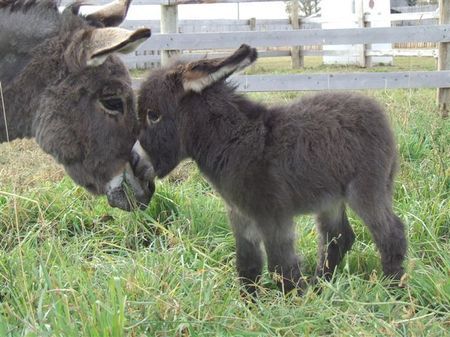
And here are the cute pictures as promised.


I now really really want a donkey.

Sunday, 24 March 2013

Sealife Sunday #1: It's actually pretty safe to go back in the water

NB: Farmyard Fridays is on hiatus this week, largely because Bullen was too busy praying for no snow to remember to post a fact. Next week's will therefore be bigger, better and have more cute pictures to make up for this.
NB2: Sealife Sundays may or may not become a regular feature.


This story caught my eye whilst scrolling through the Mail's Sidebar of Shame this week. Journalistically speaking, it's cracking: sharks now apparently have fangs and the pictures do almost nothing to illustrate the article, but it does demonstrate the general opinion of sharks. The comments tend to take the viewpoint that if you get into the water with a shark, you're asking for trouble, and this is something anybody who's seen Jaws probably agrees with. Common sense says that, like putting your head inside a lion's mouth, swimming with sharks is probably not the wisest thing to do.

It is, however, not such a stupid thing to do as all that, at least statistically speaking. Admittedly, the likelihood of bumping into a shark on a regular basis is probably infinitesimal for most people, so the numbers are slightly skewed. Even so, the following facts are interesting. Worldwide, there are less than 20 fatal shark attacks a year. This becomes even more interesting when you learn that every year, 100 deaths are caused by wasps, 150 by falling coconuts and 600-700 by both toasters and chairs. People who worry about sharks in the water should instead worry about the water itself: you are 1000 times more likely to die from drowning than from a shark attack.

Yes, in an average day, you are more likely to come across a chair or toaster, and most accidents do take place in the home. Still, it does make you rethink the image you carry in your head of a shark - and see coconuts in a very different light.

Sealife Sunday Fact #1: Sharks are statistically less dangerous than wasps, coconuts, toasters and chairs.

Thursday, 21 March 2013

Oz the Great and Powerful


I’ve always quite enjoyed The Wizard of Oz as it’s frankly an amazing feat of cinema given that it came out in 1939 – the switch from black and white to Technicolor is still magical. And the 1985 Return to Oz is another treat, in another whole way: the scariest kids’ film I have ever seen! I’ve also read Gregory MacGuire’s Wicked out of curiosity to see what all the hype was about, although it didn’t persuade me to go and see the musical.

Despite all of this, I’ve never really counted myself as an Oz fan; I’m more of a Narnia girl in general. Still, Oz the Great and Powerful has been on my ‘want to see list’ for 2013 since I heard it was coming out, and whilst I’ve been feeling pretty rundown and tired, I still wanted to see it.

A basic run down of the plot is that it explains how the Wizard came to Oz, and how the witch became wicked. Admittedly the latter part of that plot was a little tenuous and left unresolved in my mind. James Franco plays the Wizard (or Oz as he was actually known) and I spent a lot of the film wondering what else I’d seen him in. I’m still none the wiser, as having Googled it, the only thing he’s credited as being in that I’ve seen was the godawful Pineapple Express, and I’ve blocked that from my memory. The various witches of Oz are played by Rachel Weisz, Mila Kunis and Michelle Williams.

First off, I really enjoyed it. I liked the plot and it was vaguely humorous. I’m sure I’ll be struck down by somebody for saying it was a more likeable plot than Wicked as I found that just too clever-clever. I liked that things weren’t overplayed, like the encounter with the lion, and that some things about the 1939 film are directly referenced.  Franco was alright and I thought Michelle Williams was a perfect Glinda. Also, the use of 3D in the opening credits was frankly the best use of 3D I’ve ever seen; the rest of the film used it pretty much as pointlessly as any other film I’ve ever seen, but the depth on the credits was amazing.

Rachel Weisz was, for me, underused, as her part was very small in the grand scheme of things. Her character wasn’t really developed in the same way that Mila Kunis’s was. However, on the subject of Kunis, I felt she was a little miscast. For me, she’s best when she can be slightly comedic (really good in Friends with Benefits and the best thing about Ted), and her role didn’t allow her to be. She’s too light and fluffy for the frankly iconic role she was given.

Visually, the film was lovely (and how epic is the poster above?!), although I will admit that I’m becoming saddened by the overreliance of film upon CGI so that lavish sets are no longer built. Yes, the Emerald City here was amazing, but look at what Victor Fleming achieved in the Judy Garland classic without any computer effects at all. I liked the addition of China Town, even if the China Girl initially freaked me out. The monkey I could take or leave in all honesty.

This was quite a dark film so I’m surprised it was only rated a PG – definitely some scary moments for children. Actually, scratch that; some scary moments for me.

For me, though, definitely Sam Raimi’s best film.