Ramblings about books, films, cakes, weight loss and likely some terrible celebrity gossip. Politics is very unlikely.
Sunday, 9 June 2013
80 Books No.33: Memoirs of an Imaginary Friend by Matthew Green/Dicks
This was one of those books which seem to have become increasingly appealing in recent years. It was likened to both The Curious Incident of the Dog in the Night-Time and Room, and to that I would also add The Lovely Bones, The Time-Traveler's Wife and even the frankly terrible If You Could See Me Now. The title basically gives it away in that it is indeed the memoirs of an imaginary friend, a concept I was quite interested in, even having experienced the aforementioned If You Could See Me Now.
The initial concept was pretty good. It showed that the writer had really thought things through, examining the world through an unconventional narrator and throwing fresh light upon every day events. It's very un-PC to say that I was a tad frustrated that the boy in the story seemed to, once again, have some form of autism, which seems to be the disorder du jour amongst novelists. Perhaps I was more affected by coming off the back of The Way Things Look to Me, but in some ways this was a wasted opportunity to fully explore what being a child is like.
The novel took an unexpected and, for me, unnecessary turn halfway through when the boy was abducted and then held hostage, with only his imaginary friend Budo able to rescue him. Therein there was a protracted rescue attempt which had more than a small debt to pay to the film Ghost. This, however, I didn't like much; it felt out of place and incredibly random, as though the writer had realised the concept of an imaginary friend was good but not enough to sustain an entire story on its own. He was probably right.
Okay, but a bit frustrating and doesn't live up to its billing.
Also, I've found the writer listed as both Matthew Green and Matthew Dicks. The latter one seems more appropriate if he is writing under two different names for the same book.
Sunday, 19 May 2013
80 Books No. 32: The Way Things Look To Me by Roopa Farooki
I've only been keeping a list of what I've read for the last couple of years, so I can forgive myself for accidentally reading this book again - I must have first read it in 2010 or 2011. When I picked it up in the library the storyline did ring a bell, but then I've probably picked a lot of the books in the library up before so I dismissed it as simply a book I'd read the blurb of and discarded; I do that a lot.
However, once I began reading it, some of the details of the story rang a bell: some blind guy, a girl with debilitating eczema, a breastfeeding woman. The story itself was one I vaguely remembered reading. What I didn't remember was any reaction I'd had to it which was weird; I just felt largely ambivalent to it, and I still do. Some of the reasons why:
- Reason #1: I didn't really care about any of the characters. They were all pretty 2D in my opinion and had little character development in their own right. In fact, the only reason they changed at all was due to...
- Reason #2: the book seemed to claim that everything could be solved by falling in love. Lila overcame her hatred of her own body because of falling in love; Asif overcame his hatred of his own name because of falling in love; Yasmeen wondered if her life was worth living as she may never fall in love. These characters weren't especially independent. I mean, what would happen to Lila if her and Henry split up again? Was she going to start self-harming again? It sent out a very odd message in my opinion.
- (Controversial) Reason #3: it all centred around Yasmeen's autism and how it affected everybody else, and the high focus upon autism in modern popular fiction is becoming a bit tedious, something I'll explore more in my next post.
So it was okay, not amazing, not one to especially recommend.
80 Books No. 31: Guilt Trip by Anne Cassidy
So it's pretty clear by now that I'm a big fan of books about weirdo teenagers. Four of the books I've read so far this year have already been about teenagers or children doing bad things, either to themselves or to other people. I'm not sure why I keep getting drawn towards these novels; it must be some weird gene in me.
Now I've actually met Anne Cassidy through my job and so I've read a few of her books before. And her stuff can generally be typified by 'teenagers do something bad, to themselves or others'. Looking for JJ is about the rehabilitation of a child killer, whilst Just Jealous, if I remember rightly, involves a girl murdering someone by accident cause she's got some jealousy complex over her boyfriend. Her stuff is therefore a pretty safe choice of novel if what you're wanting is teenagers behaving badly. Which obviously I can never get enough of...
The jist of this story is that a group of teenagers witness a boy trying to kill himself and rescue him, only to sort of befriend him - and then wind up accidentally killing him. This secret is kept for a couple of years and then it all comes out. I make no bones about spoiling this plotline as it pretty blindingly obvious from the blurb and the entire set-up of the novel.
I'd had a massive issue with reading until reading this novel, having started and given up on A Clash of Kings, TimeRiders and something else I can't even remember right now. So this broke my dry spell so that's a good thing. The topic obviously appealed to me and it passed the time, but it's not a hugely memorable novel; already I'm forgetting things that happened in it. I think I should probably call time on Cassidy's novels now because I've never been blown away.
Tuesday, 23 April 2013
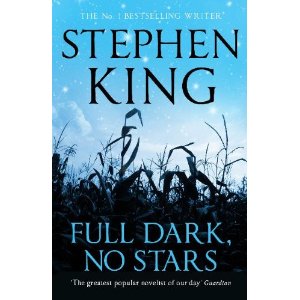
80 Books No.30: Full Dark, No Stars by Stephen King
Whilst it may seem as though I read a lot, I wouldn't consider myself well-read. I believe this primarily for the reason that the type of thing I read is very limited. I pretty much only read fiction novels. I almost never read non-fiction, autobiographies, poetry, plays or short stories. I'm basically very stuck in my ways.
However, I like Stephen King and this book was recommended on a website I visit, so this seemed as good a read as any. King's work is always readable and enjoyable, so there seemed little harm in giving this a go. The whole collection is centred around the theme of murder and whether it is ever justified. Considering it is a collection of short stories, I'll treat each one separately before summing up the whole collection (this also makes this post longer - I know all the tricks)
1922
A Nebraska farmer relates the reasons he murdered his wife and what happened as a result of it. From the outset, this was a dark and disturbing story, and it really didn't let up. The wife was, admittedly, horrible, but then this was a story narrated by a murderer: he was hardly going to make his wife sound nice! This subtly changed throughout the story, emphasising his unreliable nature. The corruption of his son was the real heart of the story, and it was a shame that the subplot involving him and his girlfriend became slightly far-fetched. In some ways, this made it less disturbing than the later stories, and yet it was this story which gave me nightmares and freaked me out. At this point in the collection, I wasn't wholly enjoying myself.
Big Trucker
A novelist is attacked on her way home from a book reading and seeks revenge. This story continued the dark nature of '1922' and took it even further. This was a more believable tale, to a point, and the graphic descriptions of the attack made it worryingly real. There was a twist in the tale, as ever with King, but it worked well. However, it was such a disturbing story that I still wasn't really enjoying this book; I could have happily given up at this stage!
Fair Extension
The story of a man who wishes to be cured from his terminal illness - and is, but you have to wonder if it is worth it. This was where the collection came alive for me. There was a change in narration style, to a more detached perspective. It was far more moralistic, in my opinion, and had more of an edge of magical realism about it than the other tales in the collection. The ending was the most disturbing part of this one as the main character did not respond how you'd want him to.
A Good Marriage
A woman discovers her husband is not the man she thought he was. It was pretty obvious from its inclusion within the collection that her husband was going to be a Bad Man. What was fascinating was how much of a Bad Man he was and how she responded to him. Whilst the initial situation was less likely than 'Big Trucker', the emotions seemed more real and true. I really enjoyed this one.
Bonus story: Under the Weather
An advertising man remembers something he has worked very hard to forget. A terrible summary for what turned out to be an excellent and devastatingly sad story. Why was this only included as a bonus in the paperback edition? Whilst the other stories were more disturbing, the emotions this one brought about were more overwhelming. Stunning.
Overall, Full Dark, No Stars is a decent enough collection. Stephen King writes beasty books (see In which size definitely matters ) and I can't always face a full 1000 pages. This was a nice little taster of readable and well-crafted tales. The title is one-hundred per cent accurate though: this really is thoroughly dark with absolutely no hope. Not to be read whilst in a depressive state of mind.
Labels:
80 Books,
books,
fantasy,
reading,
short stories,
Stephen King
80 Books No.29: Black Swan Rising by Lee Carroll
I bought this because I thought it would have some connection to Swan Lake. It sort of did, very slightly, in as much as black and white swans seemed important in some way (I sort of lost track of those bits). Mostly, however, it was to do with vampires, fairies and the sixteenth century alchemist John Dee. Which, you know, is completely logical.
Falling into a genre apparently known as 'urban fantasy', Black Swan Rising was about Garet (or Margaret dependent upon how you want to be introduced to her) who seems normal on the surface but has a lot more hidden beneath the surface. She finds out that her mother's death in a car accident was far from accidental and that there are more things in heaven and earth than are dreamed of in her philosophy.
Okay, it's essentially Twilight for a slightly older audience (I think; I don't know why but it feels more adult than Stephenie Meyer's novels).
However, this is not all bad. Being pretty much Twilight means you do get some overblown angst, a sexy vampire and a massive fight between good and evil. And the characters here are at least more likeable and perhaps more believable; they're generally quite 'normal' anyway, with, naturally, the exception of the elves, fairies and gnomes which crop up around every street corner in Manhattan. This element I liked, as all of these mystical beings lived their every day lives alongside humans, either as nurses or pawnbrokers or radio DJs. It probably shouldn't have worked, but did, and these characters were just the backdrop the novel needed.
There was logical progression in the plot and it came to what I consider a satisfying ending; it was slightly open-ended but gave a sense of closure. I would criticise Garet's almost instant acceptance of this magical world, even given her complete immersion into it, but then if she hadn't immediately got on board with it, it would have been a hell of a tedious novel! As it was, it was actually quite gripping and exciting, and I desperately wanted Garet and Will to get together even if he seemed horrendously dangerous.
A pretty decent read if you like ridiculous fantasy. Would make a good film!
Sunday, 14 April 2013
80 Books No.28: Harvesting the Heart by Jodi Picoult
Blogging about these books is proving to be an interesting experience. I'm finding out whether I truly enjoyed a book or not through the process and seeing patterns in the types of books I read. And I've just found another use for this level of detail: I won't find myself errantly re-reading a Jodi Picoult novel I've already read before.
I've an odd relationship with Picoult. I've seem to have read no less than fifteen of her novels*, some of them twice. I bought the debut novel her daughter released (with her mother's help). I've even bought a pretty awful made-for-TV movie of my favourite one of her novels The Pact. Yet she also drives me insane. It frustrates me that her books are constantly re-issued with new covers making you think she's written a new one when actually it's just a repackaging of a 1995 novel (yes, okay, not technically her fault, but bear with me...). It annoys me that so many of her novels have similar titles so you're never quite sure if you've read them or not: Harvesting the Heart/Change of Heart, easily confused. It irritates me that she takes on hard-hitting issues such as teenage suicide, child abuse, domestic violence, terminal illness and high school shootings, and sentimentalises them so much. And frankly, I've never forgiven her for the terrible endings of both My Sister's Keeper and Handle with Care, endings which basically deemed the previous four hundred pages null and void (I will however give her kudos for the ending of Salem Falls which was a brilliant twist - see, I can be nice).
So, yeah, Picoult and me don't necessarily get on, yet I still keep buying her novels. This may have a very strong link to the fact that her novels appear in charity shops on a regular basis and I'm a greater lover of buying books in charity shops. This does not necessarily reflect her ability as a writer as some of my favourite books of all time have come from second-hand stores.
So, Harvesting the Heart. I'll let the publisher's blurb give you the lowdown first:
Basically Picoult's tackling the issue of post-natal depression here, and if she'd stuck to that I might have been on board with this novel. Picoult does seem to complete some quite extensive research into the topics she covers and I reckon she could do post-natal depression pretty well. However, she isn't content with this. Instead, she decides to also cover: self-worth, the problems with marrying somebody from a different social circle to you, a random detour into horse health and ailments and a whole great dollop of Catholic guilt. Like in The Tenth Circle, the focus drifts away from what could be an interesting study to something bigger, more unwieldy and last engaging. It could have worked here, possibly, but for me it was all spoilt by the following problems.Paige has only a few vivid memories of her mother, who abandoned her when she was five. Now, having left home and her father for dreams of art school and marriage to an ambitious young doctor, Paige finds herself with a child of her own.
Emotionally and physically exhausted, overwhelmed by the demands of her family, Paige cannot forget her mother's absence or the shameful memories from her own past. Her next step would have been unthinkable before her doubts about her maternal ability crept into her mind. Is it possible Paige's baby would be better off without her?
Paige is not a likeable character. It's harsh, I've never been abandoned by my mother aged five, but the way it all keeps harping back to this incident really got me irritated. She needed to get a grip and stop blaming everybody but herself for how she felt and acted. Certain elements of her childhood also didn't ring true: her 'best friend' got her suspended from school on three occasions, and her father did nothing to stop her seeing her? She and her father seemed close and yet she just left him and barely ever phoned him? Her father himself: he seemed a bit of a drip which seemed unlikely given he'd raised Paige himself from the age of five with no help.
Perhaps Paige could have been an unlikeable character and the novel would still have worked if Nicholas, her husband, wasn't so unlikeable and one-dimensional as well. He really is horrible for ninety per cent of the novel, more interested in his career than his wife or child. Picoult broadly draws this picture of a man who doesn't understand the pressures of being a full-time parent and then re-habilitates him within pages. I can't see anybody existing exactly like him, especially not underneath the surface: he never really expresses a wish to spend more time with Paige or Max, and if this was what he was really like, I can't understand why Paige ever fell in love with him. Their courtship is stilted and weird and it's not really made clear what they see in each other, apart from their being so 'different' from each other. In the end I wished both Nicholas and Paige would abandon the baby and let him be brought up by somebody nice.
Picoult likes to experience with viewpoints and she switches here from Paige's first person narration to a third person focused upon Nicholas. This probably doesn't help with making Nicholas a fully-rounded character, but what really let the book down was the huge leaps in time. The reader jumps from their meeting and getting married to eight years in the future, where Paige seems to have been miserable forever and Nicholas seems never to have seen his wife. Do marriages like this exist? And then Picoult puts the nail in the coffin: suddenly, for no reason, there's a chapter focused upon Nicholas - back when he and Paige first met, which in part contradicts an earlier section on the same events. I had no idea why this was there, it felt misplaced and as though nobody had proof-read the final copy properly.
And then Picoult gives the reader an ambiguous ending. A messy deux es machine is shoe-horned in in order to bring a climax to the novel and what happens next is implied, but I felt the reader was owed more than this after investing so much time in these frankly unpleasant characters. What's more, the implied ending, for the reasons outlined above, made no sense.
When I'd finished, I looked at the publication date. 1992. This was only Picoult's second novel, and so my initial reaction was to consider that perhaps her writing style was still immature then and she needed more time to develop. Then I thought again, and, no, she should have been better than this, she should have been young and eager to impress. Writers with an established career might get sloppy with their writing and get away with it: look at J K Rowling. But writers at the start of their career should be better than this clumsy tome and to be honest her publishers should have called her on the messiness of this.
And yet I read it, from start to finish. If I wasn't on a tight target I'd be ashamed of myself.
I'm going to go and have one of these now in order to calm down.
* In case anybody is interested, the Picoult novels I've read are Harvesting the Heart, Picture Perfect, Mercy, The Pact, Keeping Faith, Plain Truth, Salem Falls, Perfect Match, My Sister's Keeper, Vanishing Acts, The Tenth Circle, Nineteen Minutes, Change of Heart, Handle with Care and House Rules. I've bolded the ones I would consider were worth reading if you ever wanted to.
80 Books No.27: How the Trouble Started by Robert Williams
I only recently read Robert Williams's previous novel (Luke and Jon) and I actually bought both these books in the same sale. It was probably a rather risky thing to do, buying two books by the same author, having never heard anything about either book, but hey, I'm crazy like that.
This book delivered a little more than Luke and Jon did, at least for me, with my weird obsession with disturbing evil children. In this, Donald relates 'how the trouble started' when he was eight and he was involved in the death of a young child. This leads to a move and his isolation from everybody, including his mother who blames him for the change in their lives. Now sixteen, Donald relates his growing friendship with a lonely eight-year-old boy. And, unsurprisingly, the trouble begins again...
Donald makes quite a likeable narrator, and it's that word likeable which probably makes this novel so unusual. Donald does bizarre things: he takes an eight-year-old to a haunted house and reads to him; he seems to think it is his responsibility to look after this boy as, admittedly, nobody else is doing a particularly good job. Of course, the whole initial 'trouble' is his involvement in the death of a toddler. You should hate him. But I didn't. By the end of the novel, I felt an overwhelming sense of despair and sympathy for him. From the age of eight he was set on a path he didn't seem able to scrape himself back from. His turning over of 'the trouble' in later chapters was especially interesting: he seems unsure himself as to whether what happened was a genuine accident or something he did deliberately. Here is a novel which, far from judging a character who has committed one of the ultimate crimes in our society (a review I found online illustrated the article with that searing image of the Bulger killers) brings the reader onto his side. And that's disturbing, no doubt about it.
Towards the end, I lost a sense of the timescale a little, as Donald seemed able to travel about at will without anybody missing him. The introduction of another character was a little convenient and unrealistic, and the novel leaves the reader hanging at the end. I know why writers do this, but I've always felt it's a little lazy and a bit of a betrayal of the author-reader relationship. At least give me a solid ending and don't rely upon me to think one up myself; I'm starting to feel a little like Hazel and Augustus in The Fault in Our Stars as they try to find the true ending to their favourite novel.
I would say this was a more interesting concept than Luke and Jon, at least for me, but the ending was a little too abrupt for my liking.
Subscribe to:
Posts (Atom)